|
|
|
|
|
A Story for Minnie In the mid-18th century, Catherine II (Catherine the Great), Tsarina of the expanding Russian Empire, encouraged the immigration of Germans and other Europeans to the Volga River basin. Catherine believed that the Germans and other Europeans would bring their culture, knowledge, and work ethic to Russia and serve as a model to the Russian serfs. Catherine also needed colonists to buffer Russia from nomadic Asian invaders. In 1763 Catherine presented her Manifesto. The Manifesto offered free land, a thirty-year tax exemption, freedom of religion, exemption from military service and full political autonomy for any European (except Jews) who would establish colonies on her frontier. Initially about 27,000 Germans responded to her offer. By 1798, there were more than 38,800 individuals living in 101 German-speaking colonies along the Volga River. Victimized by raiding Asiatic nomads and distrustful of the Russian serfs surrounding them, the colonists became suspicious of outsiders. For over a century the German colonists clung tightly to their ancestral heritage and language. Colonists rarely mixed with the Russians. Hardship and stark isolation on the steppe left them deeply religious and fatalistic. Life in Russia was disastrous at first. The Russian government abandoned the colonists to the elements with little provision for survival. The Germans were familiar with their lush and forested homeland but were unprepared for the treeless prairies of the Russia steppe. With few building materials and tools at hand, many lived in dugouts and caves in the early years. Disease, crop failures, harsh winters and attacks by Kirghiz tribesman plagued their first years. Over time the German colonists became very successful. They learned to farm the land, built self-sufficient communities, and eventually established businesses and factories that were prosperous in comparison with their Russian neighbors. Our Lieske ancestors were a part of this migration and a part of these successes. An excerpt from the book Russia by Sir Donald Mackenzie Wallace written from 1870 to 1875 illustrates the relationship between the German colonists and their Russian neighbors: "Of all the foreign colonists the Germans are by far the most numerous. The object of the Government in inviting them to settle in the country was that they should till the unoccupied land and thereby increase the national wealth, and that they should at the same time exercise a civilizing influence on the Russian peasantry in their vicinity. In this latter respect they totally failed to fulfill their mission. A Russian village, situated in the midst of German colonies, shows generally, so far as I could observe, no signs of German influence. Each nationality lives more majorum, and hold as little communication as possible with the other. The muzhik (Russian peasant) observes carefully – for he is very curious – the mode of life of his more advanced neighbours, but he never thinks of adopting it. He looks upon Germans almost as beings of a different world – as wonderfully cunning and ingenious people, who have been endowed by Providence with peculiar qualities not possessed by ordinary Orthodox humanity. To him it seems in the nature of things that Germans should live in large, clean, well-built houses, in the same way as it is in the nature of things that birds should build nests; and as it has probably never occurred to a human being to build a nest for himself and his family, so it never occurs to a Russian peasant to build a house on the German model. Germans are Germans, and Russians are Russians – and there is nothing more to be said on the subject." The brutal hardship and profound physical isolation of the Russian steppe transformed the culture of the German colonists. In the constant struggle to survive, hard work and frugality became pre-eminent cultural values. A German proverb says "Die Arbeit schmeckt bessar als Essen" – Work tastes better than food. Beginning in the 1870’s the Russian government initiated a series of reforms to unify and modernize the sprawling Russian Empire. These reforms brought oppressive taxes, forced military conscription (Catherine’s Manifesto had promised exemption from military service) and the imposition of the Russian language in schools. German emigrants increasingly heard from relatives and former neighbors living in the New World who wrote of the opportunities found there. It is not known if Wilhelmina Leiske, nicknamed Minnie as was her mother, was born in Germany and went to Russia as an infant or was born in Russia from German immigrant parents, however, when her family’s land lease expired in 1892, they returned to Germany and made plans to immigrate to Canada. Not being able to afford transportation that would take them directly to Western Canada, the family booked passage from Bremen to New York.
On the ship’s 1892 manifest were the eight members of the Liske Family showing their "age on arrival" — parents Friedrich Lieske age 49 and Wilhelmina [nee Echart] Lieske age 49, and children: Hedwig age 24, Max age 22, Anna age 20, Wilhelmina age 17, Laura age 15 and Rudolf age 7 — and listed as Russian.
On May 31, 1892 the Lieske family, blessedly all eight, arrived in New York Harbour and Ellis Island. Steiner describes the fear of the emigrants as they prepare themselves for entry to the new country; the fear of the immigration agents, the medical exams and of the unknown. "Yes, those are heavy hours and long, on that day when the ship is circled by the welcoming gulls, and the fire-ship is passed, while the chains rattle and the baggage is piled on the deck..." "At last the great heart of the ship has ceased its mighty throbbing, and but a gentle tremor tells that its life has not all been spent in the battle with wind and waves. The waters are of a quieter colour and over them hovers the morning mist. The silence of the early dawn is broken only by the sound of deep-chested ferry-boats which pass into the mist and out of it, like giant monsters, stalking on their cross beams over the deep. The steerage is awake after its restless night and mutely awaits the disclosures of its own and the new world's secrets. The sound of a booming gun is carried across the hidden space, and faint touches of flame struggling through the gray, are the sun's answer to the salute from Governor's Island. The morning breeze, like a ‘Dancing Psaltress,' moves gently over the glassy surface of the water, lifts the fog higher and higher, tearing it into a thousand fleecy shreds, and the far things have come near and the hidden things have been revealed. The sky line straight ahead, assaulted by a thousand towering shafts, looking like a challenge to the strong, and a warning to the weak, makes all of us tremble from an unknown fear. The steerage is still mute; it looks to the left at the populous shore, to the right at the green stretches of Long Island, and again straight ahead at the mighty city. Slowly the ship glides into the harbour and when it passes under the shadow of the Statue of Liberty, the silence is broken, and a thousand hands are outstretched in greeting to this new divinity into whose keeping they now entrust themselves." "Cabin and steerage passengers alike, soon find the poetry of the moment disturbed; for the quarantine and custom-house officials are on board,... The steerage passengers have before them more rigid examinations which may have vast consequences; so in spite of the joyous notes of the band, and the glad greetings shouted to and fro, they sink again into awe-struck and confused silence. When the last cabin passenger has disappeared from the dock, the immigrants with their baggage are loaded into barges and taken to Ellis Island for their final examination." "Before they leave the boat, they put on their best clothes, for they are anxious to look their best and make as favorable an impression as possible upon the representatives of the government;..." "The barges on which the immigrants are towed towards the island are of a somewhat antiquated pattern and if I remember rightly have done service in the Castle Garden days, and before that some of them at least had done full service for excursion parties up and down Long Island Sound....
From here we pass into passageways made by iron railings, in which only lately, through the intervention of a humane official, benches have been placed, upon which, closely crowded, we await our passing before the inspectors. Already a sifting process has taken place; and children who clung to their mother's skirts have disappeared, families have been divided, and those remaining intact, cling to each other in a really tragic fear that they may share the fate of those previously examined. One by one we pass the inspectors; we show our money and answer the questions which are numerous and pertinent. The examination can be superficial at best; but the eye has been trained and discoveries are made here, which seem rather remarkable. Four ways open to the immigrant after he passes the inspector. If he is destined for New York he goes straightway down the stairs, and there his friends await him if he has any; and most of them have. If his journey takes him westward, and there the largest percentage goes, he enters a large, commodious hall to the right, where the money-changers sit and the transportation companies have their offices. If he goes to the New England states he turns to the left into a room which can scarcely hold those who go to the land of the pilgrims and puritans. The fourth way is the hardest one and is taken by those who have received a ticket marked P.C. (Public Charge), which sends the immigrant to the extreme left where an official sits, in front of a barred gate behind which is the dreaded detention-room." "Each railroad on the Jersey shore has an immigrant room to which the newcomers are taken by ferryboats from Ellis Island. In these rooms the immigrants are kept under strict guard until the immigrant train is made up – invariably at night...."
In Western Canada a publicly-supported railway was in place and individual homestead plots had been surveyed. The Western Canadian landscape was now "open" to commercial agriculture. To this end, the last decade of the nineteenth century saw the launch of a federal immigration program that would see the Canadian West eventually filled with white settlers on an unprecedented scale. As envisioned by the Minister of the Interior, Clifford Sifton, the primary thrust behind the federal program was a massive advertising campaign which relied very heavily on posters and pamphlets. Although these items primarily targeted prospective immigrants in English-speaking countries – in particular Great Britain and the United States – they were also distributed in French, German, Flemish, Swedish, Finnish, Norwegian and Dutch
We don’t know how or when James Colin Bryan first met Minnie. We understand James C.’s first marriage (we believe his first wife’s name to be Jane) did not produce children (not confirmed) and with his second wife, Annie (last name not known thus far), produced four children. His third wife, Emily Brown, inherited the previous four children — Levi, Johnnie, Jim and Annie — and then gave birth to three more sons — Bill, Fred and Lloyd. Emily was not well when the family left Ontario and she passed away two months after they arrived in Indian Head. James Colin Bryan was granted land in Saskatchewan through the Western Land Grants and received the lands known as Part NE, Section 36, Township 17, Range 9, Meridian W2.
|
| After most of the family had grown and moved from home Wilhelmina, her husband James Colin and children, Ada, Les and Pearl moved to 7037 Duff Street. |
 |
On October 22, 1932 Wilhelmina sent her son Les to find his father. Les (age 16) found him in the wood shed at the side of the house - James Colin Bryan, at the age of 81 had suffered a fatal heart attack. Les continued to live at home after his sisters married and moved away. He and his mother cared for each other. Letters written between Les and his betrothed, Peggy Morrison, let us catch a glimpse of their life together. Wilhelmina would prop Peggy's letters on a window sill so they would greet Les when he returned home from work. Les would sometimes sign off his letters to Peggy saying that mom had coffee ready to drink before he went to bed. Wilhelmina was always remembered in the letters that passed back and forth. |
| Les had wanted to have a home ready for his new wife by the
time of their wedding in November 1940 . When purchase plans fell
through, Wilhelmina shared her Duff Street home with Les and Peggy until
they could move into their own home - she sold them one of the rental
homes.
Wilhelmina grew lonely. The investments that she and James C. had made kept her comfortable but after such a busy life as instant mother of seven when she married and having eight children of her own to raise, living alone was not a pleasure to her. She married a Mr. Janes. Unfortunately Mr. Janes was more interested in the luxuries her investments could buy him and Wilhelmina's servitude than he was in being a husband. The situation became unbearable and Wilhelmina's sons stepped in along with a lawyer and Mr. Janes left with a legal separation and a settlement. |
| Wilhelmina's blood pressure continued to troubled her.
It was in the days before medication had been developed to control high
blood pressure and Wilhelmina's condition could not be controlled by
diet.
Wilhelmina passed away on September 8, 1949. Her children gathered to celebrate her life. It was the last time they were all together. Wilhelmina was buried beside James Colin Bryan at Fraserview Cemetery in Vancouver.
Picture right: Wilhelmina'.s children left to right: Les, Ada, Elmer, Pearl, Ray, Alvin, Roy and Stan gather in September 1949 to celebrate her life. |
 |
|
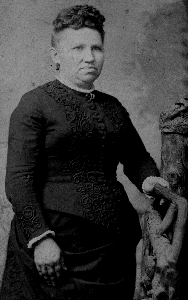
This is a biography of Wilhelmina "Minnie" Hilda LIESKE compiled by her granddaughter Sherrie Bryan (Thorne)
|
| Remembrances from family:
Not only was Wilhelmina a good mother to her husband’s children and their children, she was also a favourite aunt to nieces and nephews. Marvin and Maxine Lieske have "very fond memories of Aunt Minnie". It was somewhere around 1946 or 1947 when she last visited at their home. Marvin says, "I remember the handkerchiefs tied to resemble animals with stories to go along." Maxine reminded Marvin of Aunt Minnie "making shadows on the wall with her hands of different animals." "She just had a way with children," Marvin continued, "There was always a fight to see who got to sleep with Aunt Minnie. One morning I got teased because she said I was ‘too cuddly’. The next morning I woke up beside my Dad." |
|
|
|
It wasn’t just on her visits to their homes that Wilhelmina showed her kindness. Erna Lieske recalls "our dear Aunt Minnie". "She was a very kind and gracious lady. She took me in when I was without a place to stay in Vancouver and without money. She also helped me find a job in nursing." The hospital where Erna worked was at that time owned by James C. and Wilhelmina. Erna was teased by her husband later saying "Erna got the job because she knew the lady that owned the hospital." |